Wednesday, April 13, 2011

April is National Volunteer Month: A perfect time for all of us to get out and be great by serving our community.

“Everybody can be great because everybody can serve.” - Martin Luther King, Jr.

At United Way of the Columbia-Willamette, we focus on the building blocks of a quality life: education, income and health. With regard to volunteerism, the connection seems pretty clear. Higher education leads to a steady income and financial stability which often leads to higher volunteer rates. Volunteering has a variety of benefits, not just for the community at large, but for the individual as well. Specifically, volunteering leads to greater mental and physical health by increasing social skills, providing a connection to community and giving a sense of purpose.

I’m glad there is a month dedicated to encouraging and inspiring people to volunteer. I need the reminder myself. While I recognize and understand the importance of volunteering on a cognitive level, sometimes I need not only the push to action, but also the pause to reflect on what volunteering means to me.

According to a report released earlier this year by the Bureau of Labor Statistics (Volunteering in the United States 2010), I fit fairly neatly into the categories deemed to volunteer the most. I’m female. I’m employed and receive a Community Service Benefit from my employer. I’m 41. I’ve been fortunate to receive a college education. I’m white, unless I choose to volunteer my Mexican and Native American roots. I’m healthy and able-bodied. According to my demographics, I should be a volunteer extraordinaire!

Despite the many privileges above, I have to say, I don’t volunteer as often as I could. Because of my vantage point, it’s easy for me to find rationalizations for why I haven’t volunteered as much as I’d like. I work for a non-profit, so I’m making a contribution to the common good every day. I make other charitable contributions. I’m too busy with other hobbies, activities, family and friends. I haven’t found the right organization yet. You get the idea.

In the process of categorizing myself as a person with few barriers to volunteering, I quickly realized I could just as easily be viewed as selfish, uncaring, lazy and disinterested. I know in my heart these things aren’t true. Yet, how often do I view myself in these terms? I feel like I could do more. The privilege I have reinforces the idea that my contributions are needed and welcome.

What if I was struggling to get my GED? What if I was unemployed? What if I was in poor health? Would I still feel like my contributions are welcome? How would I fit into this structured idea of volunteerism? Would the service I provide to my family, my neighbors or my church be given as much weight in the eyes of others? How often is non-participation viewed as apathy, especially for less privileged groups?

The community benefits of formal volunteering are undeniable. When people grab hold of hands, come together and volunteer, great things are accomplished in short order. We learn about ourselves and others. In this spirit, I suggest broadening the conversation so we truly recognize the service of all people.

At the core, volunteerism is an organized way for us to show empathy for one another and experience our interdependence. In reality, we all give of ourselves every day with every interaction, although we probably don’t view it as volunteering.

So, not only will I use National Volunteer Month as a spark to rekindle my volunteer fire, I’ll also start being more aware of the informal acts of volunteerism too. Introducing myself to more of my neighbors? Why not! Holding the door for someone? You betcha! Picking up the fast food litter outside my apartment? Bring it on!

Join me in volunteering this month and throughout the year. Learn more about volunteer opportunities by visiting United Way of the Columbia-Willamette’s website at www.unitedway-pdx.org/volunteer.

“Do something wonderful, people may imitate it.” - Albert Schweitzer

Michelle House
Member, United Way Internal Diversity & Inclusion Team

Friday, April 1, 2011

My Bad Habit

I have a bad habit. Okay, I have several. One, though, is significant in terms of diversity and race. I take guilty pleasure in scanning the comments section of articles posted to the website of a local newspaper to see how long it takes for race to enter the dialogue. The phenomenon is especially common in articles regarding politics or crime.

This newspaper seems to have a policy not to include race in physical descriptions of suspected perpetrators. This policy draws the ire of many readers who suggest the paper is not doing its job by withholding this information and instead is pandering to political correctness. A reporter recently directed unhappy commentators to a PBS interactive web piece called, RACE – The Power of an Illusion, to illustrate the philosophy behind this issue. The PBS information demonstrates that race is a social construction. This construction historically benefited its more powerful architects over those from whom they sought land, property, labor or other ill-gotten commodities. RACE – The Power of Illusion instructs that, “Not one characteristic, trait or even gene distinguishes all the members of one so-called race from all the members of another so-called race.”

The “Sorting People” section of the PBS site challenges viewers to correctly identify the race of twenty different people, take a look and you will see why this is so daunting. The issue is a personal one for me. My own heritage is Irish, Native American, and French. While I am Pembina Chippewa, my mother was enrolled out of Sault Ste. Marie reservation in Michigan, meaning that she and her children would have federal recognition as Native Americans although we are not Sault Ste. Marie Chippewa, but most anyone would identify me as white. My son has about the same skin tone as me, but some would question or be surprised to know that his maternal grandmother is African American.

Herein, I believe, is the crux of the newspaper’s policy on printing suspects’ race. What angry readers really want to know is what color the accused individual is. Race, ethnicity, and color are not all the same thing. Hispanics and Latinos, or individuals whose heritage leads back to a Spanish speaking country, have skin tones that nearly run the gamut of human pigmentation. African American is a common racial classification, but is it appropriate for an individual whose family comes from Jamaica, Haiti, or Kenya? So identifying another person’s race for them is insulting and often erroneous.

None of this is meant to exhort a philosophy of “colorblindness.” We are not all the same, and that is okay. More than okay; it is wonderful, beautiful, and deeply valuable. Race is an illusion, but many of us still need ethnicity to define ourselves, our communities and provide a sense of belonging. We have not reached the point where communities of color can stop coming together to pursue, maintain, and further civil rights. Historical scars of racism have not healed and new ones appear constantly.

However, I do believe that it is important to remember that we are more than the sum of our labels, more than a color. I encourage you to visit the PBS site at http://www.pbs.org/race/000_General/000_00-Home.htm.

Colin McCormack
Member, United Way Internal Diversity and Inclusion Committee

Tuesday, March 29, 2011

Earned Income Tax Credit: Jeff and Rita Helping Families Save Money

Jeff has been working to provide free tax preparation for the past seven years, the past four of which have been spent at CASH Oregon’s Lloyd Center free tax preparation center as a site coordinator. Nearly all the people that visit the site qualify for the Earned Income Tax Credit and United Way of the Columbia-Willamette provides funds to help those clients receive the credit.

“Most of the people we help here are either surprised or delighted that they’re receiving a considerable refund or they’re counting on that money to help pay family bills,” Jeff said. “The way I see it, my job has two goals, first to make sure our clients are following all the tax laws to keep them out of trouble with the IRS and second to make sure they pay out as little as possible as allowed by tax law to help them better support their families.”

Rob Justus, Executive Director of CASH Oregon commends Jeff’s tireless efforts to save low income families money and ensure their taxes are filed correctly. “Jeff created the bar that all our tax sites adhere to for quality control,” said Rob. “Jeff developed a training course for all our tax volunteers on quality control and he makes sure we score 100% in site IRS audits meaning that all the tax returns we do are accurate.”

Rita is one of the volunteers who works three days a week to help prepare taxes for lower income individuals and families. “I enjoy being able to help people so much that I often stay so long into the evening they have to kick me out!” Rita said. “My mother used to volunteer doing tax preparation so last year I decided I wanted to help too and took the four 8 hour classes needed to become a certified tax preparer and I just love it.”

This tax season, the CASH Oregon site in Lloyd Center Mall is on track to file 3,000 returns for free, which would set a record for this location. They are expecting to file 16,000 free tax returns at all the 53 CASH Oregon tax sites combined thanks to over 300 volunteer tax preparers like Rita.

Monday, March 21, 2011

Tax Event Saves Low-Income Taxpayers Money

As part of United Way's funding of financial education services at the Community Housing Resource Center (CHRC) in Clark County, the center partnered with US Bank and the IRS last month to prepare 20 tax returns during the 2011 Homeless Connect event organized by the Council for the Homeless. Many individual tax returns were prepared placing $7,000 in Earned Income Tax funds into the hands of homeless low-income working taxpayers and a total of $15,000 in tax refunds were obtained by homeless participants at the event. Several people were also able to open direct deposit accounts with the Bank and staff at CHRC was able to connect people with community financial education and counseling resources that are available at the Center.


Monday, March 7, 2011

The "Hard Times Generation," a Personal Reflection

Last night’s 60 Minutes story on homeless children entitled “the hard times generation” seen here: http://www.cbsnews.com/stories/2011/03/06/60minutes/main20038927.shtml struck a cord for our staff at United Way.

What these children are dealing with, hunger, poverty, lack of housing are issues that United Way is working hard to address in our local community through the Community Relief Fund. The fund provides emergency food, rent and utilities assistance to help children like those profiled in this story stay in safe homes, with the lights and heat on and food on the table.

Maria Rubio, United Way’s Diversity and Inclusion Director had the following personal emotions when she saw the story:

What makes this interesting for me is that the middle class is slowly disappearing. Unfortunately, millions of people grew up and/or have been living like this for generations because of similar circumstances (this idea of “the working poor”) like having to decide if they buy groceries or pay the light bill. Their children’s education suffers because the kids cannot concentrate in school and have to carry the burden of feeling responsible for their family’s situation. Eventually this leads to bad grades, absenteeism, and dropping out.

It’s really sad that these kids are learning what it’s like to live in poverty. I know that for me, growing up in a migrant farm worker family moving from town to town to harvest crops and living in labor camps, it didn’t seem as bad because I was with my 10 siblings and 2 parents. We learned to work hard from a very young age (5yrs old - before the child labor laws precluding children under 12 from being in the fields working). Like the boy in the video, I quit school during my senior year to work with my brother to help pay for the rent in Hillsboro after the labor camp closed for the winter. It’s hard to imagine that 40 years later, children from previously middle-class families are repeating this cycle.

I loved what the 10-year-old girl in the video said that because of going through this experience, she will understand what it’s like when she gets out of this situation and encounters others going through it. It’s a hard lesson, but one that will help her in the future.

It's frusterating to think how easily and in such great numbers people are being evicted and literally put out on the street. These families are the working poor, making more than $20,000 a year which is not enough to provide for a family of four but is above the federal poverty threshold for many government services so they’re on their own, struggling. If we could keep more people in their homes, children would maintain their self-esteem and do much better in school.

This story may have been based in Florida but our local community is dealing with the exact same problems. I firmly believe the work that United Way of the Columbia-Willamette does here in the Portland metro area can help solve these problems. Our community needs emergency funds to help people stay in their homes and pay their utilities and we’re working to do that through our Community Relief Fund. But we also need ongoing support that goes beyond emergency needs like mentoring, referrals, and funds for supportive programs, all things United Way provides for the community. 
Help us make a difference for our local families struggling, donate to United Way’s Community Relief Fund today.

Thank you,
Maria Rubio
Director, Diversity and Inclusion
United Way of the Columbia-Willamette

Friday, February 25, 2011

2011 Nonprofit Salary & Benefits Survey: Sign Up to Participate!

Don't miss your chance to participate in the MBL Group's 6th edition of the premier compensation and benefits survey for Oregon and SW Washington nonprofits. The 2011 survey will provide comprehensive information for 86 benchmark positions and 14 benefit and pay topics. Whether you are a large or small employer, rurally located or in the heart of the urban environment, your participation is critical.

Top 4 Reasons to Participate

Ignorance is not bliss. The more you know about competitive pay and benefits practices in your market, the better decisions you can make for your organization.

Timing is everything. The economic recession led to dramatic challenges for organizations, many of which took direct actions related to pay and benefits. As organizations stabilize and reset, it is critical to have current, relevant, and reliable data on nonprofit compensation and benefit trends in our region.

There is safety in numbers. Including your data supports decisions made in our own organizations and in organizations throughout our region. It is one simple step which makes our community stronger.

You can't afford not to. A small investment of your time today helps ensure long-term success in attracting and retaining talent for your organization's future.

Learn more or sign up to participate today!

Participation is free and all participants receive a complimentary Executive Summary. The survey will open March 1 and runs through March 31. Participants receive up to a 67% discount off the purchase price, and Nonprofit Association of Oregon members receive an additional 10% discount.

Monday, January 17, 2011

When I Think of Dr. King...

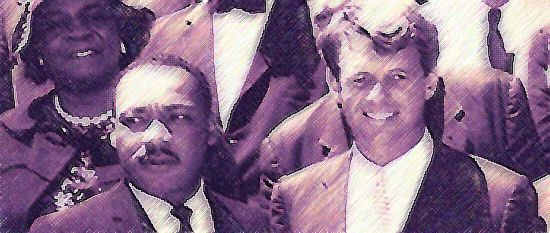
I’ve been thinking about Martin Luther King, Jr. this week. To be honest, I think about him quite often.   I remember when he walked among us, and I remember when he was assassinated. That day we lost a great leader and I recall how great numbers of cities across the country broke out in riots.  The emotional trauma felt by our country was palpable.  At the time, the shock, sadness, and sense of loss compared to when President John F. Kennedy was assassinated only five years earlier. 

Little did we know that just two months after losing Dr. King, we would lose another champion of civil rights in Senator Robert Kennedy. Because they died in such close proximity, I can’t think of one without thinking of the other. I was 16 and their loss had a life-changing impact on me. They were great men doing great things; and then they were gone. Just like that.


I think of the significance of two leaders, ages 39 and 42, one black and one white, who died that year working for peace and justice. Is there a lesson there for us … for me? Is it about the need to carry on the work, together?

Through the years I’ve wondered what our country would be like if they were still here. I’ve wondered why Dr. King felt a need speak out, and to go where there was injustice that didn’t impact him personally. Like first responders run toward a disaster, he ran toward injustice, not away from it.

Today, I’m thinking of Dr. King because it’s his holiday. As I head out to volunteer, I’m inspired by his life and by his work. I’m in awe of his wisdom and his strength. Most importantly, I feel responsible for doing my part to help Dr. King’s dream become a reality for us all:


“I have a dream that one day this nation will rise up and live out the true meaning of its creed: We hold these truths to be self-evident that all men are created equal.”


- Maria Rubio
Director of Diversity and Inclusion
United Way of the Columbia-Willamette